Kevin Weil Launches Warp Sciences: What His Leap From OpenAI Teaches Ambitious Founders
Warp Sciences arrived on 22 October with the kind of launch most founders only daydream about: $215 million raised, an $865 million valuation and a lead investor that says it committed in the very first meeting. The man behind it is Kevin Weil, who until recently ran OpenAI for Science after serving as the company’s Chief Product Officer. On paper it looks like a victory lap. Look a little closer and it is something more interesting, a seasoned operator walking away from one of the most talked-about companies on earth to do slow, physical, unglamorous work in a chemistry lab.
That choice is the real story here, and it carries lessons for anyone thinking about their next move, whether you are running a startup or quietly planning to leave a comfortable job.
What Warp Sciences Actually Does
Strip away the buzzwords and the idea is simple. Before a new drug ever reaches a human trial, chemists spend years making thousands of slightly different versions of a promising molecule, testing each one and using the results to design the next. This stage is called lead optimization, and it is painfully slow. According to Lightspeed, which led the round, good contract labs aim to finish one design cycle in two to three weeks, and a full program usually takes two to four years.
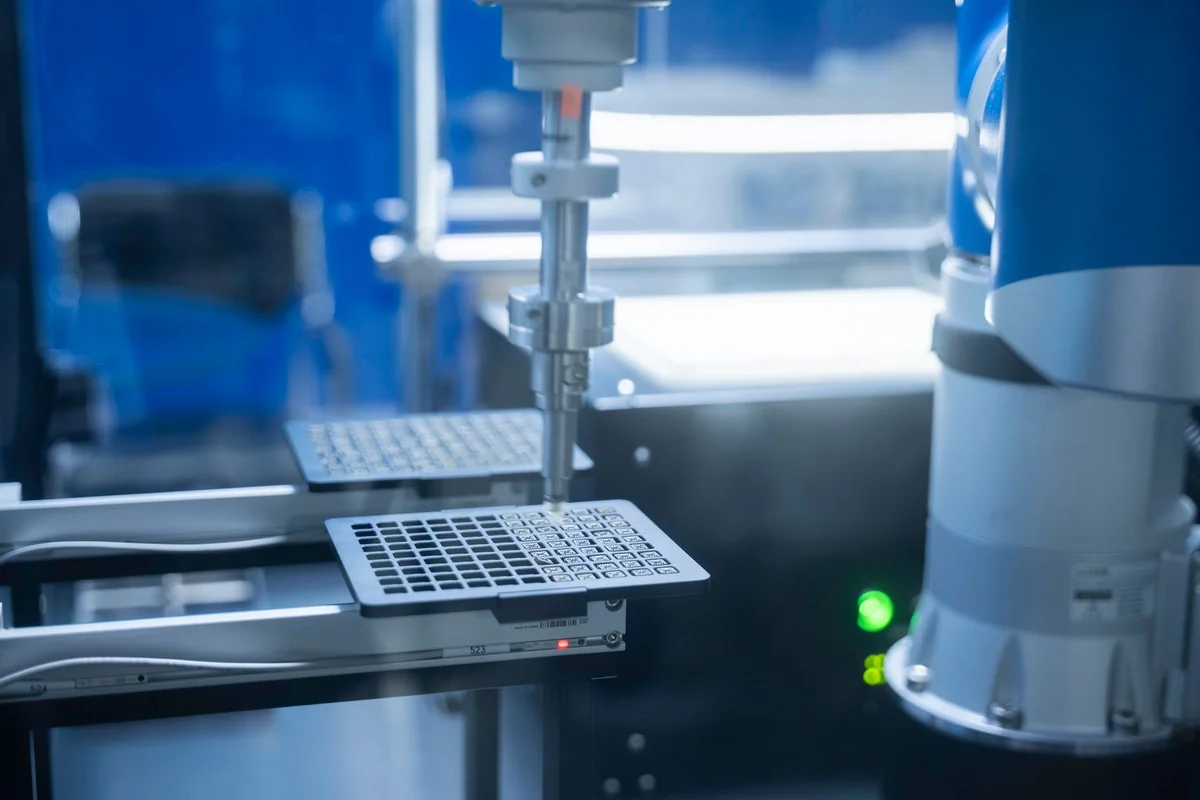
Warp Sciences wants to compress that. Its human chemists, wearing cameras and sensor gloves, will train robots to handle the repetitive steps such as setting up reactions and purifying samples. The robots can run around the clock. Every experiment, including the ones that fail, gets recorded in a form an AI model can learn from. The company’s first customers will be pharma and biotech firms that need this chemistry done, and later it plans to sell predictions about which compounds are worth making at all.
There is also a geography angle. Much of this outsourced chemistry has been sent to contractors in China for years, and TechCrunch notes that Weil wants to bring that work back to the United States. With the BIOSECURE Act now law, plenty of American drug companies are suddenly very interested in a domestic option.
Who Is Backing It
Lightspeed led the round, joined by IVP, Mayfield, Lux Capital, Premji Invest and Menlo Ventures. The founding team is unusually stacked. DJ Patil, the first US Chief Data Scientist, is chief operating officer. Sol Reisberg, a medicinal chemist who has taken five drugs into the clinic, is chief scientific officer. Mano Paluri, who helped found Meta’s AI research lab, leads the model and robotics work.
Lesson One: Follow the Bottleneck, Not the Hype
Here is what I find most impressive about this launch. Weil spent his last stretch at OpenAI working on making AI models better at science. He could easily have started yet another company building yet another model. Instead he looked at where the real constraint sits. An AI can suggest a brilliant molecule in seconds, but somebody still has to make it and test it in a lab before anyone trusts it. As Lightspeed puts it, a chemist working by hand rarely runs more than about ten reactions a day.
That is the bottleneck, and Warp is going straight at it. It is a useful question for any founder or professional to ask: where is the thing that is actually slowing everyone down? It is usually less exciting than the headline technology, and that is exactly why it is often wide open.
Lesson Two: Your Career Is a Set of Building Blocks
Weil’s resume reads like a tour of the last twenty years in tech. He studied physics and maths at Harvard and physics at Stanford, led product at Twitter and Instagram, ran product and business at the satellite company Planet, and then went to OpenAI. None of those jobs was about chemistry. All of them were about turning complicated technology into products people use.
Warp is where those blocks finally fit together: the science training, the product instincts, the experience with hardware at scale and the AI work. If your own career feels scattered right now, this is worth remembering. Skills compound in ways you cannot always see while you are collecting them.
Lesson Three: Leave While You Are Curious, Not Bitter
Plenty of people leave big companies because they are burned out or pushed out. Weil appears to have left because the most interesting problem he found was outside the building. Lightspeed quotes him saying earlier this year, before he left OpenAI, that “the science of the future will definitely involve robotic labs and reinforcement learning loops that go through the real world.” He then went and built one.
There is a big difference between running away from something and running toward something. The second kind of exit tends to produce far better work, because the energy is pointed forward.
Lesson Four: Treat Failure as Data
One detail in the Warp pitch deserves more attention than it gets. Published lab data leans heavily toward successes, because reactions that fail rarely get written up. Yet those failures are some of the most valuable training data a model can have. Warp records every step of every run, including the ones that go wrong, and keeps them.
I love this as a metaphor, but it is also just good business. Most of us quietly bury our failed experiments, the pitch that flopped or the project that went nowhere. A company that deliberately saves its failures is building an advantage nobody else bothers to collect. You can do the same with a simple habit: write down what did not work and why, every single time.
Lesson Five: Build a Team That Covers Your Blind Spots
Weil is a product and technology leader, not a medicinal chemist, and he clearly knows it. Reisberg spent years buying services from offshore labs, so he knows exactly where customers get frustrated. Patil brings healthcare data and government experience, which matters for a company leaning into US policy. Paluri brings deep AI research. It is a team built around gaps rather than egos.
If you are building anything, from a startup to a side project like the teenager behind our story on CruiseCup and its 3D printing business lessons, the people you bring in early shape everything that follows.
The Honest Caveat
None of this guarantees success. Drug discovery is brutally hard, robots in wet labs are still a young technology, and big funding rounds raise expectations fast. Warp has to win real customers, deliver real compounds and prove that its data loop actually makes the lab faster. You can read the original launch coverage on TechCrunch.
Still, the shape of the decision is worth studying. A founder with every easy option available picked the hard, physical problem sitting underneath the hype. That is a choice more of us could make in our own work.
Related reading
- Ivan Burazin’s Daytona Hits a $1 Billion Valuation: Lessons From a Founder Who Built Twice
- Blacksmith Hits a $1 Billion Valuation: What Three Waterloo Founders Teach About Boring Markets
- Tractian Hits a $1.4 Billion Valuation: Founder Lessons From a Paper Mill Childhood
FAQ
What is Warp Sciences?
Warp Sciences is a US company that combines expert chemists, AI and robotics to run drug discovery chemistry for pharma and biotech firms, starting with lead optimization work.
Who founded Warp Sciences?
It is led by CEO Kevin Weil, formerly OpenAI’s Chief Product Officer and head of OpenAI for Science, with DJ Patil, Sol Reisberg and Mano Paluri on the founding team.
How much did Warp Sciences raise?
The company raised $215 million at an $865 million valuation in a round led by Lightspeed, with IVP, Mayfield, Lux Capital, Premji Invest and Menlo Ventures also taking part.
What can founders learn from Warp Sciences?
Look for the real bottleneck rather than the trendiest technology, treat failures as valuable data, and build an early team that fills the gaps in your own experience.




1 comment on “Kevin Weil Launches Warp Sciences: What His Leap From OpenAI Teaches Ambitious Founders”