Looksmaxxing Went Mainstream: Are Men Really in the Gym for Their Health — or to Be Desired?
Health is the answer most men give. Desire is often the engine the data keeps finding.
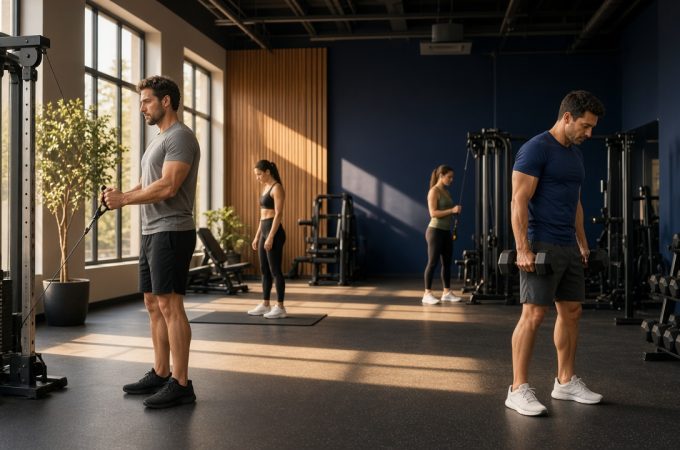
Walk into a serious gym at seven in the morning and you will hear a clean story: longevity, VO2 max, a back that will still work at sixty. It is a good story, and for many men it is true. It is not the whole story. A parallel current has gone mainstream under a harsher name — looksmaxxing — and the research on why men train has been quietly saying the same thing for years: health is the alibi, attraction is often the assignment.
What men say, and what they reward
YouGov, in a June 2024 snapshot of American men’s health habits, found that among men who exercise regularly, 46 percent prioritise appearance over health as a motivator for diet and exercise. That is not a fringe. That is nearly half.
In the United Kingdom, PureGym’s UK Fitness Report for 2023–24 found that 42 percent of men who work out cited overall health as a main goal, ahead of appearance at 29 percent, with 22 percent focused on building muscle. Health still leads when you ask the question directly. Add appearance and muscle together, though, and you have a second, very large current running through the same locker room. A 2025 analysis of Reddit fitness discussions in the Journal of Medical Internet Research found physical appearance was the most commonly stated motive, at 23.9 percent, ahead of physical health at 18.9 percent — a self-selected online sample, not a census, but a telling one.
The evolutionary scoreboard, and its limits
None of this arrives from nowhere. In 2017, Aaron Sell, Aaron Lukazsweski and Michael Townsley reported in Proceedings of the Royal Society B that estimates of upper-body strength accounted for more than 70 percent of the variance in men’s bodily attractiveness. When they added tallness and leanness, the figure rose to about 80 percent. In their samples the relationship was linear: the strongest men were rated the most attractive, with no evidence for the popular idea of a mid-range sweet spot.
“Estimates of physical strength determined over 70% of men’s bodily attractiveness.”Sell, Lukazsweski and Townsley, Proceedings of the Royal Society B, 2017
An earlier paper by David Frederick and Martie Haselton, in Personality and Social Psychology Bulletin in 2007, found that muscularity is valued — and that men often overestimate how much muscle women want. The science explains a pull. It is not a licence to chase an extreme, and it does not say a physique is the same thing as a life. We have written before about six-pack abs, a lean physique, and what actually shapes attraction.
Looksmaxxing, in from the forums
The word itself has travelled. As The New York Times (November 2023), The Guardian (February 2024) and BBC Culture (March 2024) have all documented, looksmaxxing began in niche online forums and then exploded on TikTok, teaching a generation of young men to treat the face and the body as a score to be maximised. At the mild end it is skincare, sleep and the gym — ordinary self-respect, rebranded. At the hard end it shades into steroids, surgery and other risky practices that doctors have condemned.
That hard end is not a wellness trend. The NHS is clear that misusing anabolic steroids to get bigger is not a path to health: it can cause serious side effects and addiction, and it can be bound up with body dysmorphic disorder, a condition in which a person is consumed by flaws others often cannot see. A 2025 study in the journal Body Image, drawing on the Study of Boys and Men in Canada and the United States, found that more frequent viewing of muscularity-oriented social media content was associated with probable muscle dysmorphia, independent of total time spent online.
Health and desire are not enemies — unless the feed becomes the only mirror
So is the male fitness craze for health or for attracting women? The honest answer is both, and the proportions shift with age, with culture and with the honesty of the person asked. Self-determination theory is useful here: training that a man has chosen, that makes him more competent, and that connects him to a team or a partner, can serve health and desire at once. Training that exists only to pass a test in someone else’s eyes is a different sport, and a colder one.
The physique of a global athlete has a market price — see Celebrityfees on the highest-paid athletes of 2026 — but the work that built it began as a standard, not a selfie. For the energy to train without wrecking the nervous system, see our 18-hour energy blueprint. For the hunger that outlasts the trophy, see why the world’s greatest athletes are still hungry. For what lasts after the body, the brand and the highlight, see the motivation that outlasts money, fame and romance.
Train for the life, not only the mirror. Discover Everyday Vitality by Richiegaps, a daily ritual for the health side of that choice — not a transformation dare.
This article is not medical advice. If training, body image or substance use is causing distress, seek help from a qualified clinician. The NHS publishes guidance on anabolic steroid misuse and body dysmorphic disorder.